
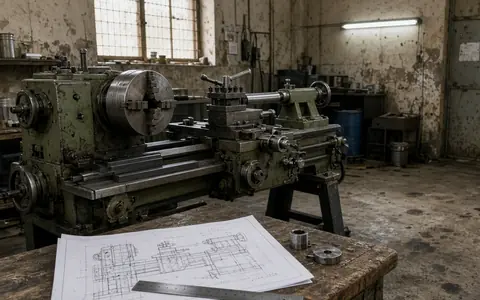
This one is a job-work workshop. Mild steel, a lathe, a couple of machines that take a drawing. Buyers send a photo on WhatsApp and wait for a rate. It is an SME in the ordinary Indian sense: a small or medium enterprise, not a named brand, not a listed company, and not a shop that sells off a shelf. It is not a hardware counter, a coaching centre, a grain desk, or a kirana that already takes WhatsApp orders. Those were other problems. This floor had a different one, and it does not use invented enquiry counts, ranking jumps, or rupee figures.
What the buyer actually types
People who need a one-off part rarely search the owner’s first name. They type job work near me, fabrication unit, CNC job work plus the city, or MSME workshop when a purchase order needs a GST invoice. That is local SEO in the language Google already ranks: Google Business Profile, Maps, and a website a crawler can read. Organic search still sends the walk-in and the RFQ. AI Overviews and answer engines only cite a page that exists.
This workshop had none of that. The Google Business Profile was unverified, or it sat under a category that described a retail shop. The phone on the listing, when there was a listing, was a personal number. There was no website. Digital presence, for a stranger, was a forwarded chat.
What arrived on the phone instead
Work still came. Relatives forwarded a drawing. A contractor who already had the number sent a voice note. That is not a digital transformation strategy. It is a closed circle. The jobs that start with “who does this in this town?” never reached the gate. They reached the competitor who had claimed the Maps pin and put a short page behind it.
WhatsApp is a good conversation once someone has chosen you. It is a poor front door. A photo of a drawing in a personal chat is not a catalogue, not an RFQ, and not digital commerce. The owner could not point a new buyer to a URL. Staff could not answer hours or capacity without asking him. Ads, if they had bought them, would have landed in the same chat.
The door they actually needed
They did not start with an ERP, a shop-floor app, or a paid campaign. Digital transformation for this SME was narrower: own the search the buyer already makes.
First, claim and verify Google Business Profile. Match name, address, and phone to the board. Put the right category for job work, not a generic store. Hours the gate actually keeps. No keyword stuffing in the Maps name. That is the local pack for near me.
Second, a thin website they own: what the floor can take, the city, a tap to call, a tap to WhatsApp, and a form that files the drawing as an enquiry instead of a personal chat. That page is digital presence and the first step of digital commerce. It is also the source GEO needs if an AI answer is going to mention the trade at all.
Third, stop treating forwards as marketing. One offer, on the page, in the language the counter speaks. SEO here is crawl, index, rank — starting with a listing a crawler can read. IEO is matching that page to the job of the query (compare a unit, then send a drawing), not to a blog about Industry 4.0.
The same question, in a trade that is not job work
The useful part is the search the stranger types, not the machine on the floor. Who owns that query?
A cold-storage unit can live on WhatsApp slots and still lose “cold storage near me” to a neighbour with a verified profile. A printing press can quote on forwarded PDFs and still be invisible for “offset printing” plus the city. A transport desk can fill trucks from known parties and still miss “tempo service near me”. A small hotel can sit on an OTA and still fail “hotel near the station” on Google. The trade changes. The missing door does not.
A retail shop that already takes WhatsApp checkout is a different case. There the question is whether the chat is also the ledger. Do not paste a checkout rule onto a job-work floor, and do not paste a Maps walkthrough for a hardware aisle onto a B2B RFQ. Pick the query the buyer actually uses.
What this workshop does not prove
They can point at a listing a stranger can open, and at a form that is not a personal chat. They cannot claim a rank, a lead multiple, or a utilisation rate. Those depend on the town, the machines, and the season. We do not publish a figure this floor cannot show from its own enquiries. They also left the signboard name as it is. Stuffing the Maps name with extra machine words would not have created the page.
For the wider habit of a public page plus WhatsApp, see why WhatsApp still needs a website and digital presence, AI search, and local SEO. The work on this floor is narrower than a full digital transformation roadmap: one search, one listing, one page they own.
Questions from the floor
Does an SME need a website if WhatsApp already takes drawings?
WhatsApp can take a drawing from someone who already has the number. A stranger who searches job work near me, fabrication unit, or CNC job work plus the city needs a Google Business Profile and a page they can open without saving a chat. The website is the door. WhatsApp stays the conversation after they have chosen you.
What is Google Business Profile for a workshop that is not a shop?
It is the listing Google shows for local SEO and Maps. Category, hours, the same name-address-phone as the board, and a tap to call. Job-work buyers still search near me. If the profile is missing, the organic search result goes to a competitor who claimed it.
Will AI Overviews mention a workshop with no page?
ChatGPT, Perplexity, and Google AI Overviews cite pages they can read. A WhatsApp thread is not that page. Digital transformation for an SME starts with a source a crawler and an answer engine can both use.